
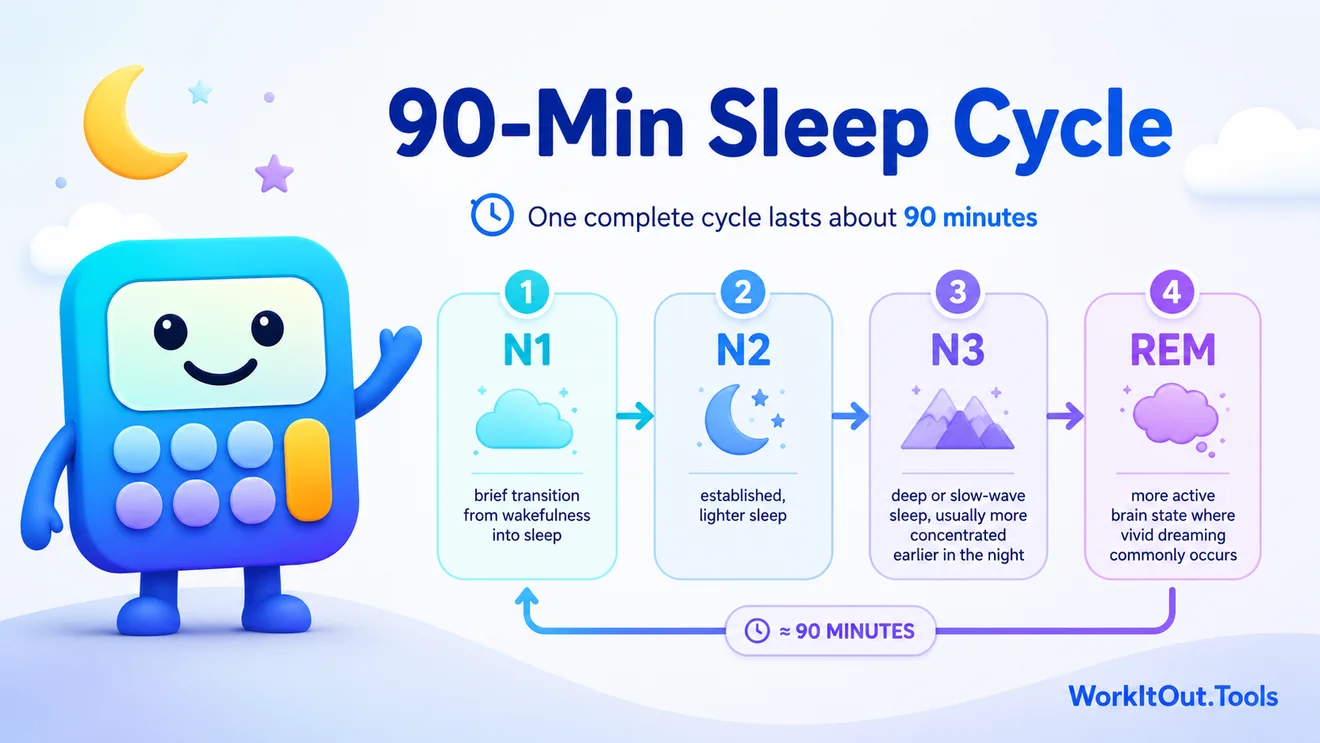
What is the 90-minute sleep method?
The 90-minute sleep method is a bedtime-planning shortcut. It assumes one sleep cycle lasts about 90 minutes, then counts forward or backward in complete cycles to suggest when you should sleep or wake. Five cycles equal about 7.5 hours asleep, and six equal about 9 hours.
The method is useful for rough planning, not precise sleep-stage prediction. Use 90 minutes as a ruler, not a stopwatch.
Why did the 90-minute sleep method go viral?
The idea is catchy because it gives people a bedtime they can calculate in seconds. Start with an alarm time, count back five or six 90-minute sleep cycles, add time to fall asleep, and suddenly a messy sleep decision feels like a simple plan.
That is also why the 90-minute sleep cycle method keeps resurfacing online: it is personal, repeatable, and easy to test the same night. The catch is that real sleep cycles vary, so the viral version works best as a planning shortcut, not a promise that your alarm will land on the perfect sleep stage.
The backstory has its own article: trace how a simple bedtime calculator idea became football coverage, TikTok sleep advice, and a repeatable online sleep hack.
Related article
How the Sleep Cycle Method Went Viral
Trace the 90-minute sleep rule from an early bedtime calculator to Ronaldo headlines, TikTok sleep hacks, and what the viral trend leaves out.
Read how the sleep cycle method went viralWhat actually happens during a sleep cycle?
Sleep is not one continuous state. During a typical night, you move repeatedly through non-REM and REM sleep:
- N1: the brief transition from wakefulness into sleep.
- N2: established, lighter sleep.
- N3: deep or slow-wave sleep, usually more concentrated earlier in the night.
- REM: a more active brain state where vivid dreaming commonly occurs.
The pattern repeats, but not as a set of identical loops. Early cycles usually contain more deep sleep, while later cycles usually contain more REM. For plain-English definitions of sleep cycles, REM, deep sleep, sleep latency, circadian rhythm, and sleep inertia, use the WorkItOut.Tools sleep glossary.
The science versus the shortcut
| The science | The viral shortcut |
|---|---|
| Sleep moves through recurring non-REM and REM stages. | Every cycle lasts exactly 90 minutes. |
| Cycle length varies between people and across one night. | Your cycles finish at predictable clock times. |
| Total sleep, circadian timing, continuity, and individual need all matter. | Completing a neat number of cycles is treated as the main goal. |

How to calculate sleep cycles with the 90-minute rule
- Choose the time you need to wake up.
- Choose five or six cycles. Five cycles is about 7.5 hours asleep. Six cycles is about 9 hours.
- Count backward in 90-minute blocks.
- Subtract your sleep latency. If you take 15 minutes to fall asleep, get into bed 15 minutes earlier.
- Check the total sleep time. Do not choose a short option only because it completes a theoretical cycle.
The Sleep Calculator runs both directions and lets you compare the classic cycle result with a duration-based plan and a flexible sleep window.
Five sleep cycles versus six
| Plan | Estimated time asleep | With 15-minute sleep latency | Best interpretation |
|---|---|---|---|
| 4 cycles | 6 hours | 6 hours 15 minutes in bed | Usually too little for an adult, not a hack. |
| 5 cycles | 7 hours 30 minutes | 7 hours 45 minutes in bed | A plausible adult option if it meets your needs. |
| 6 cycles | 9 hours | 9 hours 15 minutes in bed | The longer option, if your schedule and sleep need suit it. |
Public-health guidance recommends at least seven hours for most adults. That makes four 90-minute cycles a poor default for many people. Finishing an imaginary perfect cycle does not make chronic sleep restriction harmless.
Worked example: what time should I sleep to wake at ?
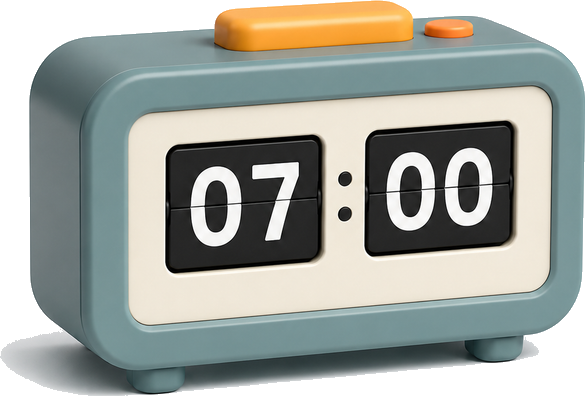
Using the classic 90-minute rule and allowing 15 minutes to fall asleep:
| Option | Calculation | Estimated asleep | Get into bed |
|---|---|---|---|
| 6 cycles | - 9 hours | ||
| 5 cycles | - 7.5 hours |
Bedtime is not the same as sleep onset. If the method says a cycle begins at and you usually need 15 minutes to drift off, you need to be in bed at about .
Does waking at the end of a sleep cycle make you feel better?
It can, but a clock-based calculation cannot guarantee that you will actually wake at a cycle boundary. The heavy, confused feeling after an alarm is called sleep inertia, and waking from deeper sleep can make it worse.
Your alarm may still catch you in deeper sleep because your cycles were not exactly 90 minutes, you fell asleep earlier or later than expected, you woke during the night, or sleep debt changed the pattern.
Why can you sleep for 7.5 hours and still wake up exhausted?

Five theoretical cycles may look perfect on paper while the night itself is not perfect. Common explanations include:
- Sleep latency: 7.5 hours in bed may contain less than 7.5 hours asleep.
- Night-time awakenings: fragmented sleep reduces continuity.
- Sleep debt: several short nights can leave a deficit that one timed night does not erase.
- Circadian timing: waking during your biological night can feel difficult.
- Sleep quality: pain, noise, temperature, alcohol, stress, and health conditions can affect the night.
This is where adjacent tools answer different questions. A Sleep Debt Calculator can look across several nights, while the 90 minute nap calculatorhandles shorter daytime sleep windows.

The smarter way to use the 90-minute sleep method
- Anchor the plan to a realistic wake-up time.
- Protect enough total sleep first.
- Include the time you take to fall asleep.
- Treat five and six cycles as broad options.
- Compare the cycle method with a duration-based plan.
- Judge the pattern across repeated nights, not one morning.
That is the useful version of the viral method: a simple planning framework, with its assumptions left visible.
Try it with your own wake-up time
Use the free Sleep Calculator to work backward from your alarm, adjust sleep latency, and compare the 90-minute sleep cycle method with other bedtime estimates.
Open the Sleep Calculator
How the Sleep Cycle Method Went Viral
Trace the 90-minute sleep rule from an early bedtime calculator to Ronaldo headlines, TikTok sleep hacks, and what the trend leaves out.
Read article
Nap Calculator Guide: Choose a Power Nap or 90 Minute Nap
Choose a 10 to 20 minute power nap, avoid grogginess, or plan a 90 minute nap with time to fall asleep included.
Read article
How to Calculate Sleep Debt
Use the sleep debt formula step by step, see worked examples, and learn how to catch up on sleep debt gently.
Read articleFrequently asked questions
Are sleep cycles really 90 minutes?
Not exactly. Ninety minutes is a useful average. Public sleep guidance describes sleep cycles as variable, and clinical references describe later cycles that can last longer than the first cycles of the night.
Is five or six sleep cycles better?
Six cycles provide about nine hours asleep, while five provide about 7.5 hours. Neither is automatically better for everyone. Choose the option that fits your sleep need and daytime functioning.
Does the 90-minute calculation include time to fall asleep?
Only if the calculator adds sleep latency. If you usually need 15 minutes to fall asleep, your get-into-bed time should be 15 minutes earlier than the estimated start of your first cycle.
Can a sleep calculator tell when I am in REM or deep sleep?
No. A clock-based sleep calculator uses averages and your inputs. It cannot measure brain activity or guarantee that your alarm will land at a REM, deep sleep, or sleep-cycle boundary.
Sources
- National Heart, Lung, and Blood Institute: Sleep phases and stages Sleep stages, typical cycle range, and cycles per night.
- Centers for Disease Control and Prevention: About Sleep Recommended sleep duration by age.
- Watson et al.: Recommended Amount of Sleep for a Healthy Adult AASM and Sleep Research Society adult consensus recommendation.
- NCBI Bookshelf: Physiology of Sleep Changing sleep cycle length and sleep architecture across the night.
- Hilditch and McHill: Sleep inertia, current insights Effects of sleep stage, prior sleep loss, and circadian timing on sleep inertia.
Image sources
- 90-minute sleep cycle guide header image AI-generated image supplied for the WorkItOut.Tools guide header and social preview.
- Understanding the 90-Minute Sleep Cycle diagram AI-generated diagram supplied for the WorkItOut.Tools guide.
- Tired person photo by ThuyHaBich, Pixabay Used for the section about waking exhausted after 7.5 hours of sleep.
- WorkItOut.Tools calculator mascot with lightbulb AI-generated image supplied for the smarter 90-minute sleep method section.
- WorkItOut.Tools calculator mascot with question marks AI-generated image supplied for the sleep-cycle calculation section.
- Seven in the morning flip clock image AI-generated image supplied for the worked sleep-cycle example.