

Quick answer
Use a 10 to 20 minute power nap when you want a fast alertness boost. Use a 90 minute nap when you have enough time for deeper recovery. Be careful with 30 to 60 minute naps, because they are more likely to end during deeper sleep and leave you groggy.
To use a nap calculator like a power nap timer, set your alarm for:time you lie down + time to fall asleep + nap length.
Use the Power Nap Calculator to choose a nap length and set a phone alarm for the right wake-up time.
Why a nap calculator beats a plain timer
A phone timer can count minutes, but it does not know whether those minutes are spent asleep. If you want a 20 minute power nap and usually take 5 to 10 minutes to drift off, a simple 20 minute alarm may only give you 10 to 15 minutes of actual sleep.
The Power Nap Calculator handles that missing step. Enter when you can lie down, choose the sleep length you want, add sleep latency, and use the calculated wake-up time as your alarm.
Best nap lengths for a power nap, short nap, or 90 minute nap
There is no single perfect nap length. The best choice depends on whether you need quick alertness, deeper recovery, or a nap that will not interfere with nighttime sleep.
| Nap length | Best for | Timer setting | Grogginess risk |
|---|---|---|---|
| 10 minutes | Tiny alertness reset | Set aside about 15 minutes if you need 5 minutes to fall asleep. | Low grogginess risk |
| 20 minutes | Classic power nap | Set aside about 25 to 30 minutes if you need time to settle. | Low grogginess risk |
| 30 minutes | Longer short nap | Use when 20 minutes feels too short, but leave wake-up buffer time. | Medium grogginess risk |
| 45 to 60 minutes | Deeper rest when you cannot take 90 minutes | Use cautiously. This is the zone most likely to feel heavy afterward. | Higher grogginess risk |
| 90 minutes | Full-cycle nap | Set aside about 95 to 105 minutes if you include sleep latency. | Lower than many mid-length naps |
Mayo Clinic guidance says a 20 to 30 minute nap is ideal for many adults and notes that longer naps are more likely to cause grogginess. Napping earlier in the afternoon is usually safer for nighttime sleep.
How to set a power nap timer without a built-in countdown
WorkItOut.Tools does not currently run a live countdown timer. The calculator gives you the alarm time to use in your phone, watch, or clock app.
- Choose when you can lie down.
- Pick the nap length: 10, 20, 30, 45, 60, or 90 minutes.
- Add your usual time to fall asleep.
- Set your alarm for the calculated wake-up time.
Example: if you lie down at 1:30 pm, want a 20 minute nap, and usually take 5 minutes to fall asleep, set the alarm for 1:55 pm.
20 minute nap vs 90 minute nap
Choose a 20 minute nap when the job is alertness. It is short, easier to fit into a break, and less likely to push you into deeper sleep. Choose a 90 minute nap when the job is recovery and you have enough time to wake up properly afterward.
CDC/NIOSH training material describes brief naps and roughly 90 minute naps as useful ways to reduce the chance of waking from deeper sleep. That does not make the 90 minute number exact, but it is a better planning target than an arbitrary middle-length nap.
If your real problem is repeated short nights, check theSleep Debt Calculator. A power nap can help today, but it will not fully replace a regular sleep schedule.
Why some naps make you feel worse
The heavy feeling after waking is usually called sleep inertia. It can affect alertness and performance after sleep, especially when you wake from deeper sleep. That is why the calculator marks many 45 to 60 minute naps as a grogginess risk.
Sleep inertia is also why “longer” is not always better. If you only have a short break, a 10 to 20 minute nap may be cleaner than trying to force a 45 minute nap into the day.
For plain-language definitions, read the sleep glossary. For the longer cycle explanation, read the 90-minute sleep cycle guide.
Calculate your nap wake-up time
Use the calculator to compare a 20 minute power nap, a short recovery nap, and a 90 minute full-cycle nap from the time you can actually lie down.
Use the Nap Calculator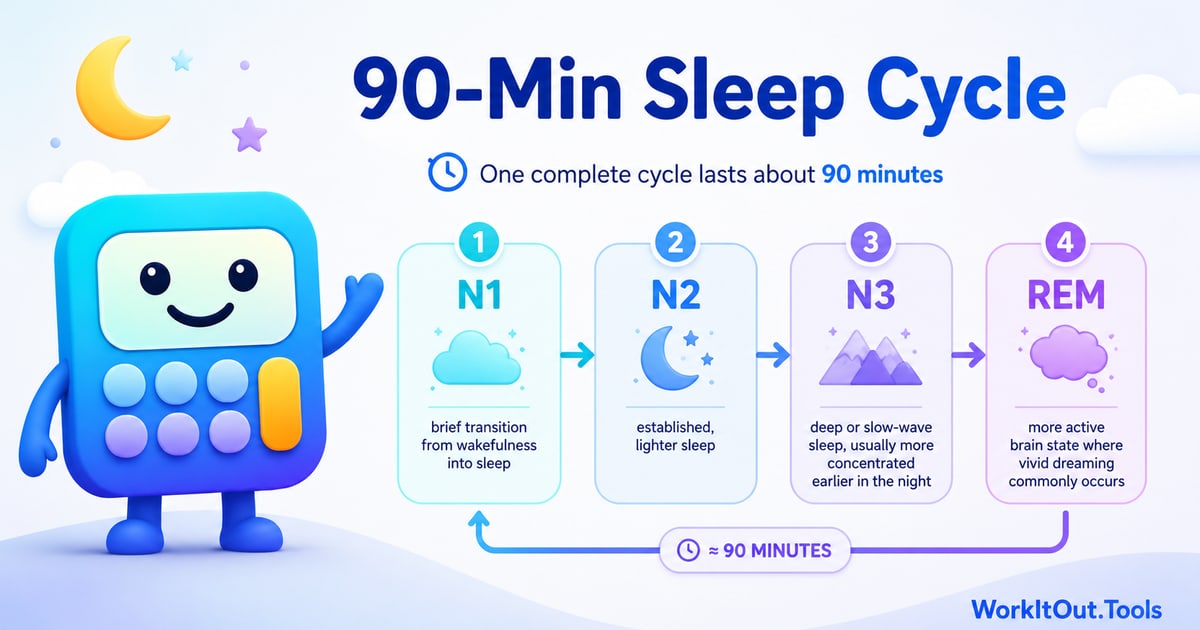
90-Minute Sleep Cycle Guide
Use the 90-minute sleep cycle formula to plan a bedtime or wake-up time, then see why real sleep cycles vary.
Read article
How the Sleep Cycle Method Went Viral
Trace the 90-minute sleep rule from an early bedtime calculator to Ronaldo headlines, TikTok sleep hacks, and what the trend leaves out.
Read article
How to Calculate Sleep Debt
Use the sleep debt formula step by step, see worked examples, and learn how to catch up on sleep debt gently.
Read articleFrequently asked questions
What is the best nap length?
For a quick daytime reset, 10 to 20 minutes is usually the best nap length. Choose 90 minutes when you have enough time for a fuller sleep-cycle nap.
How do I use a nap calculator like a power nap timer?
Choose when you can lie down, estimate how long you take to fall asleep, then add the nap length. For example, a 20 minute nap with 5 minutes to fall asleep needs a 25 minute alarm block.
Is a 20 minute nap or 90 minute nap better?
A 20 minute nap is better for a quick alertness lift. A 90 minute nap is better when you have time for deeper recovery and want to avoid the middle-length grogginess zone.
Why do I feel worse after a nap?
You may have woken during deeper sleep, napped too long, napped too late, or started with a larger sleep-debt problem. Mid-length naps are more likely to create sleep inertia for some people.
Sources
- Mayo Clinic: Napping do's and don'ts Guidance on short naps, early afternoon timing, and grogginess risk.
- CDC/NIOSH: Nap duration Work-hour training note on brief naps, 20-minute naps, and roughly 90-minute naps.
- Hilditch and McHill: Sleep inertia review Review of sleep inertia, grogginess after waking, and why timing matters.