
1
What sleep were you aiming for?
Set the target
target sleep x nights8 hours x 7 nights = 56 hours
This is your planned sleep for the period.Sleep debt guide
Sleep debt, sometimes called sleep deficit, is easier to understand once you turn it into a simple gap: the sleep you aimed for minus the sleep you actually got. Use this guide for the sleep debt formula, then use the sleep debt calculator when you want the answer for your own nights.
Start with the formula
Use this when you want to calculate missed sleep across one night, a work week, or up to two weeks of sleep logs.
What sleep were you aiming for?
target sleep x nights8 hours x 7 nights = 56 hours
This is your planned sleep for the period.How much did you actually sleep?
night 1 + night 2 + night 36h 30m + 7h + 6h = 19h 30m
Count naps only if you want total daily sleep.What is the gap?
target total - logged total24h - 18h 30m = 5h 30m
A positive gap is estimated sleep debt.Quick answer
Multiply your nightly sleep target by the number of nights you want to check, then subtract your total logged sleep. If the result is above zero, that gap is your estimated sleep debt.
Worked method
The formula is deliberately simple because it is a planning estimate. It does not measure sleep quality, sleep stages, or medical causes of poor sleep. It gives you a practical number for the gap you can see.
| Step | Example | Why it matters |
|---|---|---|
| Choose your target | 8 hours per night | This is the amount of sleep you were aiming for. |
| Choose the nights | 3 nights | The calculator supports 1 to 14 nights, so a week is easy to check. |
| Multiply target by nights | 8 x 3 = 24 hours | This gives the total sleep target for the period. |
| Subtract logged sleep | 24h target - 18h 30m logged = 5h 30m debt | The difference is your estimated sleep debt. |
Examples
These examples show why small nightly gaps can matter. A one-hour shortfall does not look dramatic, but repeated across the week it becomes easier to feel.
| Pattern | Target | Logged sleep | Estimated result |
|---|---|---|---|
| One short night | 8h target x 1 night | 6h 30m logged | 1h 30m sleep debt |
| Busy three-night stretch | 8h target x 3 nights | 18h 30m logged | 5h 30m sleep debt |
| Typical work week | 8h target x 5 nights | 35h logged | 5h sleep debt |
| On-target week | 8h target x 7 nights | 56h logged | 0h sleep debt |
Recovery planning
You can catch up on some recent sleep debt, but the better plan is usually steady recovery. If you missed 5 hours, adding 30 to 60 minutes on several nights is easier to maintain than trying to fix the whole gap with one long sleep.
Use the sleep calculator when you need a realistic bedtime or wake-up time. If you only have a daytime recovery window, use the power nap calculator, but treat naps as support rather than a full replacement for regular nighttime sleep.
Meaning and tool choice
The meaning is the gap. The calculator is the working tool. A definition helps you understand sleep debt as an idea; the calculator helps you estimate whether your own week is a small miss, a moderate sleep debt, or a larger pattern worth fixing.
For related terms, use the sleep definitions glossary. For cycle timing, read the 90 minute sleep cycle guide. For the full set of sleep tools, start from the sleep tools hub.
Check your own week
Enter the nights you know, choose your target sleep, and see the estimated sleep debt plus a gentler recovery pace.
Open the Sleep Debt Calculator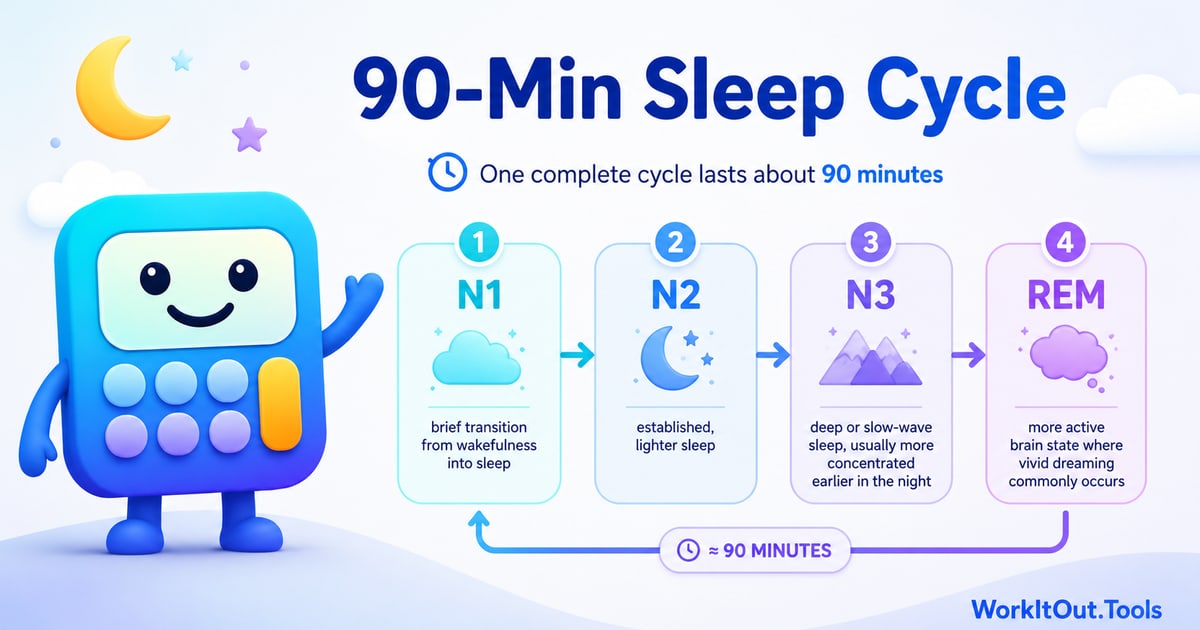
Use the 90-minute sleep cycle formula to plan a bedtime or wake-up time, then see why real sleep cycles vary.
Read article
Trace the 90-minute sleep rule from an early bedtime calculator to Ronaldo headlines, TikTok sleep hacks, and what the trend leaves out.
Read article
Choose a 10 to 20 minute power nap, avoid grogginess, or plan a 90 minute nap with time to fall asleep included.
Read articleFAQ
The simple sleep debt formula is: nightly sleep target multiplied by number of nights, minus total sleep logged.
Choose your nightly sleep target, multiply it by 7, then subtract the total sleep you logged across the week.
You can reduce recent sleep debt by adding extra sleep across several nights. A slower recovery pace is usually more realistic than trying to fix the whole gap in one night.
Count naps if you want total sleep for the day. Leave them out if you want a stricter overnight-only sleep debt estimate.
References