Did the 90-minute sleep method start on TikTok?
No. One of the earliest clearly documented online versions was a simple bedtime calculator launched in 2010. The calculator spread through early social platforms, blogs, and mainstream coverage. The rule later gained celebrity appeal through elite football before TikTok creators repackaged it as a short sleep hack.
TikTok did not invent the 90-minute rule. It removed almost everything that could not fit inside the video.
The viral 90-minute method in five waves
| Period | Version of the idea | What made it spread |
|---|---|---|
| 2010 to 2012 | A tiny interactive bedtime calculator | Personalised, instant, and easy to test |
| 2015 to 2017 | The R90 elite-performance story | Football credibility and celebrity association |
| 2021 | A short-form medical explainer | The method compressed into one video |
| 2022 onward | 7.5 hours could beat eight | A surprising, highly debatable claim |
| 2023 onward | Surveys and recurring coverage | The hack became an established sleep meme |
The important pattern is not simply that the audience grew. The message changed shape at every stage.
Wave one: the calculator that made sleep personal
In October 2010, a developer posted a weekend project to Hacker News. The idea was stripped back to its essentials: enter the time you needed to wake, and the calculator counted backwards in 90-minute blocks to suggest possible bedtimes.
The original submission attracted only a small discussion. Then the tool escaped its launch page. Its developer later described traffic arriving through Reddit and StumbleUpon, followed by technology blogs and mainstream coverage. By February 2012, he reported that the calculator was receiving about 30,000 visits per day.
That traffic figure was the developer's own account rather than independently audited analytics, but the wider appeal is easy to understand. The tool did not ask visitors to learn sleep architecture. It turned one scientific-sounding assumption into a personal answer.

Wave two: elite football gave the method a famous face
The calculator made the method useful. Elite sport made it aspirational. British sleep coach Nick Littlehales had worked around professional football since the late 1990s. His approach, known as R90, encouraged athletes to think about recovery in 90-minute units rather than obsessing over one conventional eight-hour block.
By 2015, Littlehales was being profiled in connection with Manchester United, Chelsea, Real Madrid, and Cristiano Ronaldo. His message was broader than a viral bedtime calculation: it covered recovery across a week, chronotype, travel, sleeping environments, and rest around demanding schedules.
Broad systems do not make neat headlines. Famous footballers do. Coverage often reduced the idea to a stranger claim: Cristiano Ronaldo sleeps five times every day. The precise daily Ronaldo routine was never established as cleanly as the headlines suggested, but the association did its work.

Wave three: TikTok compressed it into seconds
In April 2021, physician and social-media creator Dr Karan Raj posted a video explaining what he called the 90 minute rule. Coverage at the time reported that it reached more than 1.6 million views.
The structure was ideal for short-form video: name a familiar frustration, offer a surprising explanation, provide a memorable number, and give the viewer a calculation they can try tonight.
The video did not create the method. It rediscovered a format that had already proved shareable. The early calculator made the rule clickable. TikTok made it repeatable.
Wave four: the 7.5-hours claim pushed it further
A later version from creator Addison Jarman reportedly passed 9.3 million views. This time the framing had an even stronger hook: 7.5 hours of sleep might leave you feeling better than eight hours.
The arithmetic looked satisfyingly complete: five times 90 minutes equals 7.5 hours. Eight hours might interrupt the next theoretical cycle. Therefore, 7.5 hours could supposedly produce an easier awakening.
That is more shareable than saying sleep cycles vary, total sleep matters, and an alarm cannot predict your sleep stage. It sounds precise, challenges conventional wisdom, and creates debate. Both agreement and disagreement help it spread.
People did not just watch it. They tried it.
The trend crossed from content into behaviour. In March 2023, an American Academy of Sleep Medicine survey found that 18% of surveyed US adults said they had tried sleeping in 90-minute increments.
This does not prove that the method improved their sleep, and it should not be read as a precise measurement of everyone's behaviour. It does show that the idea travelled beyond passive views. By then, the method was no longer tied to one calculator, one athlete, or one TikTok. It had become a reusable sleep meme.
Why this particular sleep method spread
| Viral ingredient | How the 90-minute method uses it |
|---|---|
| A memorable number | 90 minutes is easier to repeat than a variable biological range. |
| Personalisation | Anyone can calculate an answer from their own alarm time. |
| Immediate testing | It can be tried the same night without buying anything. |
| A scientific foundation | Sleep cycles are real, which makes the simplified rule sound credible. |
| Celebrity association | Ronaldo transformed a calculation into a performance story. |
The most powerful feature may be the combination of personalisation and simplicity. The arithmetic is identical for everyone, but entering your own alarm time makes the answer feel individually calculated.
What got lost when the story was shared
- Cycles average around 90 minutes became every cycle is exactly 90 minutes.
- Several possible bedtimes became perfect bedtimes.
- Elite athletes manage recovery became Ronaldo sleeps five times per day.
- Sleep stage can contribute to grogginess became 7.5 hours is better than eight.
- Allow for the time it takes to fall asleep often disappeared completely.
The simplification does not make the underlying concept entirely false. Sleep really does move through recurring stages. But the precise clockwork promised by many viral versions goes beyond what a basic calculation can know.
For the science rather than the backstory, read how 90-minute sleep cycles really work.
Viral does not mean false, but it does not mean proven
The enduring appeal of the rule comes from its kernel of truth. Sleep is cyclical. The stage and biological time at which you wake can influence short-term grogginess. Planning sleep before a fixed alarm is usually better than leaving bedtime to chance.
The problem is false precision. Sleep cycles are not reliably 90 minutes long, the mixture of stages changes through the night, and a calculator cannot see whether your brain will be in REM, deep sleep, or lighter sleep when the alarm sounds.
Use the rule as a planning approximation. Keep total sleep, sleep latency, consistency, and daytime functioning in view.
Try the honest version of the 90-minute method
Use the WorkItOut.Tools Sleep Calculator to count cycles, adjust time to fall asleep, and compare the viral 90-minute result with duration-based and flexible-window estimates.
Open the Sleep Calculator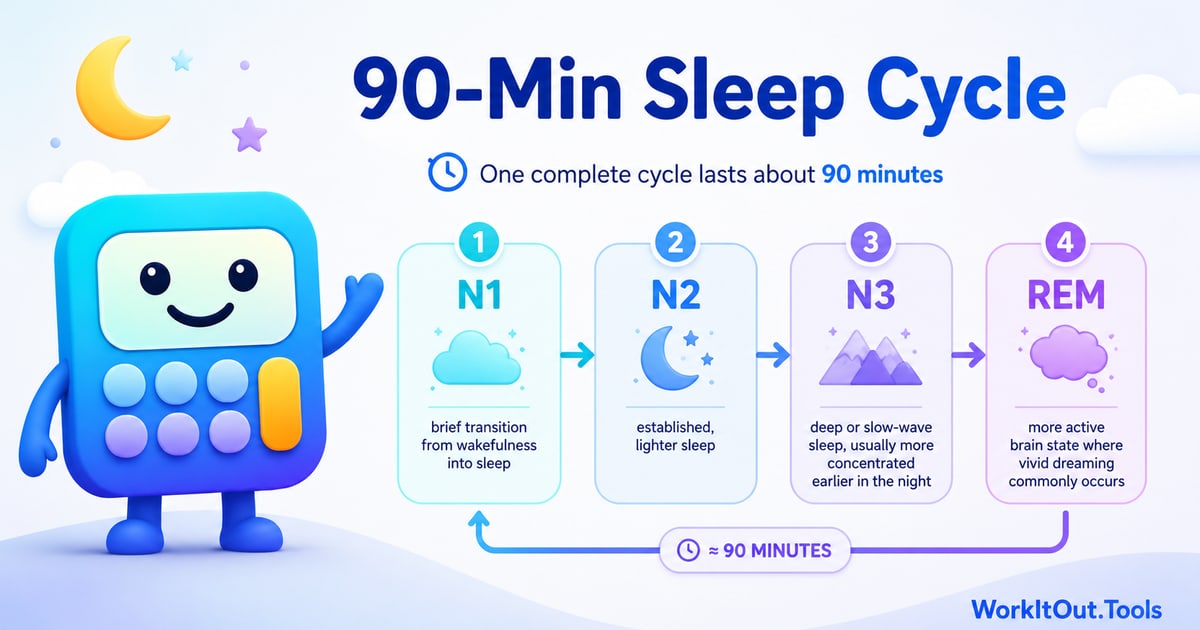
90-Minute Sleep Cycle Guide
Use the 90-minute sleep cycle formula to plan a bedtime or wake-up time, then see why real sleep cycles vary.
Read article
Nap Calculator Guide: Choose a Power Nap or 90 Minute Nap
Choose a 10 to 20 minute power nap, avoid grogginess, or plan a 90 minute nap with time to fall asleep included.
Read article
How to Calculate Sleep Debt
Use the sleep debt formula step by step, see worked examples, and learn how to catch up on sleep debt gently.
Read articleFrequently asked questions
Did the 90-minute sleep method start on TikTok?
No. A simple online bedtime calculator was already using the 90-minute method in 2010. TikTok later made the idea faster to explain and easier to repeat.
Who invented the viral 90-minute sleep rule?
There is no single confirmed inventor of the modern viral rule. Sleep cycles were studied long before social media, and different developers, coaches, and creators turned the approximate cycle length into calculators, performance systems, and short-form advice.
Why did the 7.5-hours versus eight-hours claim spread?
It is simple, surprising, and easy to test. Five 90-minute blocks equal 7.5 hours, so the claim sounds precise, even though real sleep cycles vary and 7.5 hours is not automatically better than eight.
Does going viral mean the method is scientifically accurate?
No. Sleep cycles are real, but exact 90-minute timing is a simplified planning assumption. A viral view count measures attention, not accuracy.
Sources
- Original developer launch post, Hacker News Early 2010 launch discussion for a simple 90-minute bedtime calculator.
- Developer's account of the calculator's growth Self-reported traffic and distribution history from 2012.
- The Guardian: Nick Littlehales and elite-sport sleep coaching Context for the R90 system and football coverage.
- Sky Sports: Littlehales on weekly recovery cycles Elite football, Ronaldo association, and weekly recovery-cycle framing.
- Indy100: report on Dr Karan Raj's 90 minute rule video Short-form social-media coverage from 2021.
- Mic: viral TikTok sleep hacks Reported view count and analysis of the 7.5-hours versus eight-hours framing.
- American Academy of Sleep Medicine: viral TikTok sleep trends Survey data on adults trying sleep trends, including 90-minute increments.
- American Academy of Sleep Medicine: later social-media sleep habits coverage Later context on recurring viral sleep habits.
Image sources
- AI-generated Ronaldo sleep-cycle article image Lead image supplied for the WorkItOut.Tools article header.
- Hacker News logo, Wikimedia Commons Used for the early calculator launch section.
- Sleeping person photo by Annie Spratt, Unsplash Used for the section about people trying the method.
- Cristiano Ronaldo photo by qianxie1201, Pixabay Used for the Ronaldo and elite football recovery section.